

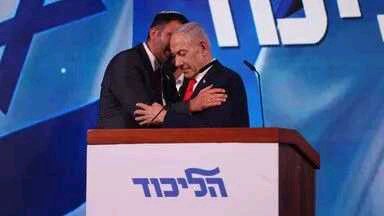
According to a report by Al-Jazeera on Wednesday, October 28, 2026, Israeli Prime Minister Benjamin Netanyahu’s political bloc has maintained its lead in the country’s parliamentary election, securing a projected 55 seats as more than half of the ballots have been counted.
Data from Israel’s Central Elections Committee showed that approximately 2.8 million ballots, representing about 56 per cent of the total, had been counted, with Netanyahu’s Likud party remaining the largest individual party.
Likud secured 20.7 per cent of the votes counted so far, followed by former military chief Gadi Eisenkot’s Yashar party with 16.7 per cent.
Former Prime Minister Naftali Bennett’s Together alliance ranked third with 9 per cent, according to the partial results.
Figures reported by Israeli media, including The Times of Israel, projected 55 seats for Netanyahu’s bloc, compared with 49 seats for the opposition. Arab-led parties were projected to secure 16 seats.
The figures indicate that Netanyahu’s camp has recovered ground after initial exit polls suggested that his right-wing and far-right political allies might struggle to secure a parliamentary majority.
However, the partial results do not establish a clear path to forming a government, as neither of the two main political camps has reached the 61 seats required for a majority in Israel’s 120-member Knesset.
With counting continuing, the final distribution of seats is expected to determine the next phase of political negotiations, as rival parties seek to assemble a coalition capable of governing.
The potential role of smaller parties, particularly those representing Arab voters, could prove significant in determining which political camp ultimately forms the next government.
Mansour Abbas, leader of the United Arab List, also known as Ra’am, has reportedly said he has received calls from different political camps, including representatives associated with Eisenkot’s opposition grouping and Netanyahu’s Likud party.
Such contacts highlight the importance of coalition negotiations in Israel’s parliamentary system, where parties frequently need the support of smaller political groups to secure a governing majority.
Although the Arab-led parties were projected to win 16 seats collectively, their willingness to support or cooperate with either major camp could depend on policy commitments and the terms offered during negotiations.
Once the final results are established, Israel’s president will consult political representatives before selecting a candidate to attempt to form a government.
The designated candidate initially receives 28 days to assemble a coalition, although the president can grant an additional 14 days if necessary, bringing the total period to 42 days.
During this period, political parties are expected to engage in intensive negotiations over government policies, ministerial appointments and other concessions in exchange for parliamentary support.
The candidate must seek to secure the backing needed to establish a functioning government, usually through a coalition agreement involving several parties.
If the designated candidate fails to form a government within the allotted period, the process may move to another candidate under Israel’s constitutional arrangements.
Parties may also explore alternative arrangements, including a minority government that relies on support from other lawmakers without formally including them in the governing coalition.
Power-sharing agreements, including arrangements involving rotating prime ministers, may also be considered if rival political groups can reach an agreement.
A new government must ultimately win a confidence vote in the Knesset. Although a majority of the 120-member parliament would normally mean at least 61 votes, the number of affirmative votes required in practice can be lower if some lawmakers abstain or are absent, depending on the applicable voting rules.





Leave a Reply