

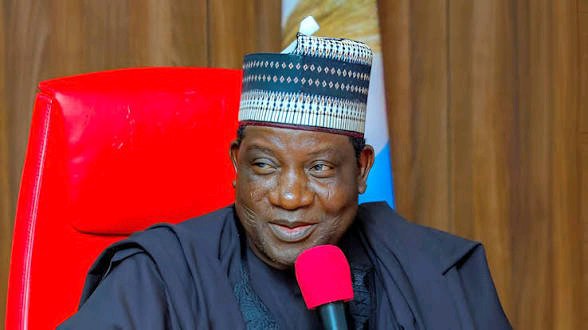
Former Governor of Plateau State, Simon Lalong, has revealed the challenges he faced regarding the Muslim-Muslim ticket of the All Progressives Congress (APC) during the 2023 presidential election.
In an interview with The Sun Nigeria on Sunday, May 24, 2026, Lalong reflected on his tenure and the period leading up to his exit from office as governor, expressing a profound sense of honour and personal dignity despite attempts by political detractors to erase his legacy in Plateau State.
He admitted that the role he played as Director-General of the campaign for Bola Ahmed Tinubu was exceptionally arduous, imposing heavy burdens on his family, his party, and his professional standing.
While he initially doubted the possibility of victory under such intense scrutiny, he remained hopeful and eventually helped deliver the presidency.
Lalong said, “I was the director general of a Muslim/Muslim ticket in a Christian environment. It wasn’t easy for me, I must confess. Not only for me, it was not easy for my party, it was not easy for my family. We went through a lot. I never knew we would get it (the presidency), but I was very hopeful that we would deliver the president.”
He noted that the subsequent political momentum led to an influx of members returning to the party, which now boasts more than 30 governors across the country.
The nomination of Bola Ahmed Tinubu and Kashim Shettima, both Muslims, represented a departure from the unwritten Nigerian political convention of balancing presidential tickets between the nation’s two major religions.
This decision ignited fierce national debate, particularly among Christian leaders who viewed the arrangement as a deliberate move to sideline the faith.
The Christian Association of Nigeria and other stakeholders raised alarms, arguing that the ticket threatened the country’s secular foundation and ignored the necessity of religious diversity in power sharing.
This friction exacerbated existing ethno-religious tensions, leading to internal party crises and the alienation of various voting blocs who perceived the strategy as exclusionary…..See More



Leave a Reply